Couples Matching Loungewear: Plan Size Pairing and Bundle Packing
Table of Contents
Couples matching loungewear can be sold as coordinated individual outfits or as a combined bundle. Those two retail models create different order and packing requirements. Buyers need to decide how sizes pair, how complete outfits are identified and how a bundle count relates to garment quantities. A clear matrix prevents a visually coordinated collection from becoming a confusing packing task. This guide addresses that operational decision while keeping each wearer's fit and each complete set's approved specification intact.

Start with the relevant Xiuxinyang product or service reference, then confirm the proposed materials and construction for your order.
Choose the retail unit before calculating quantities
State whether the customer buys one complete outfit or a bundle containing two complete outfits. Identify all garments included in each unit and confirm the supplier's supply model. Where a product is supplied as a complete top-and-trouser set, do not assume the components can be ordered separately. Keep bundle planning above that complete-set structure. A bundle description should tell the supplier exactly what is packed together without accidentally changing the product into a mix-and-match component order.
Create a matrix of approved size combinations
List the size of each complete outfit in the couples matching loungewear bundle and assign a code to the combination. Do not assume both wearers need the same nominal size. Keep the approved component pairing within each outfit and the pairing between outfits as separate decisions. Confirm which combinations are feasible for the project. A clear matrix allows merchandising to order the intended assortment and gives packing staff a reference that does not depend on interpreting labels informally.
Translate bundle quantities into complete-set demand
Calculate how many complete outfits of each size and color are needed to fulfill the approved bundles. Reconcile the total with any individual-set orders and keep the two retail models distinguishable. Include sample or replacement units only when they are actually agreed, rather than hiding them in the main quantity. Ask the supplier to confirm its quotation unit. A price per complete outfit cannot be compared directly with a price for a two-outfit bundle without matching the scope.
Keep coordinated appearance separate from identical fit
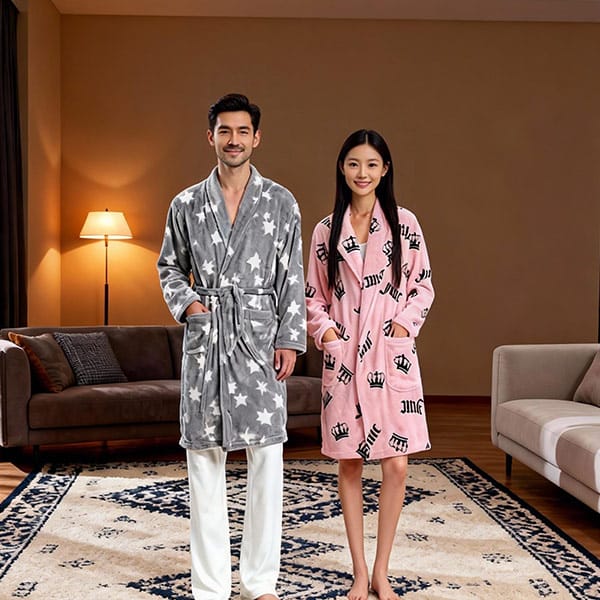
Couples matching loungewear can coordinate through color, fabric or print while using different patterns and measurements. Keep each approved garment reference distinct and connect them through the bundle code. Review the outfits together for visual relationship, but do not let matching appearance override individual fit approval. If the two designs use different constructions, compare their shade and care behavior deliberately. A shared theme does not require every component to have identical dimensions or a single universal size chart.
Specify the bundle identifier and label hierarchy
Decide which identifier belongs on each complete outfit and which belongs on the outer bundle package. Include enough information to check contents and support the buyer's receiving process. Confirm destination-market labeling requirements with the responsible party, keeping required garment information separate from a commercial bundle sticker. For couples matching loungewear, a readable outer description helps packing staff, but it cannot replace the approved labels and specifications of the garments inside. Keep codes consistent across the purchase order and packing file.
Approve a physical bundle packing trial
Assemble representative approved couples matching loungewear size combinations using the proposed packaging. Check that the contents fit without distorting garments or hiding required information. Confirm that each complete outfit remains identifiable when the customer opens the bundle. Record the presentation order and the actual packed dimensions. Different size combinations may create different volume, so review representative cases rather than one convenient sample alone. Ask the supplier to identify any packing adjustment that changes material, cost or the intended retail appearance.

Use a content check before the bundle is sealed
Compare the two complete outfits with the bundle matrix before closing the package. Check style, color, size and component count, then record the checked bundle identifier. Do not rely only on a count of loose tops and trousers. An apparently correct garment count can conceal an incorrect combination. Keep any exception outside the completed quantity until it is resolved. The packing process should make it possible to find and correct an error before the bundle reaches the buyer.
Reconcile packed bundles with remaining complete sets
At the end of packing, compare finished bundle counts with the approved matrix and the complete outfits consumed. Investigate leftover sizes, duplicate codes and missing combinations. Confirm whether any unbundled complete sets are intentional individual orders or unresolved exceptions. Keep that reconciliation with the final packing list. For repeat orders, refresh the demand matrix instead of copying the previous size mix. The approved packing structure can be reused, while the actual combinations and quantities remain order-specific commercial decisions.
A practical decision example
Compare one change at a time
Suppose a buyer plans a bundle containing one complete outfit in size M and another in size L. Ten bundles require ten M outfits and ten L outfits, with the approved top-and-trouser pairing preserved inside each outfit. If five individual L outfits are also ordered, total L demand becomes fifteen complete outfits. The order file should show the bundle and individual quantities separately and reconcile them to the total. A packing trial then confirms that both outfits are identifiable inside the bundle. These numbers are illustrative planning inputs, not a supplier minimum or a sales forecast. The example demonstrates why a bundle matrix is more reliable than a message asking for matching pairs in mixed sizes.
Decision table
| Record | Example meaning | Check |
|---|---|---|
| Complete outfit code | One approved top-and-bottom set | Preserve component pairing |
| Bundle code | Two specified complete outfits | Match matrix |
| Bundle quantity | Number of retail bundles | Translate into complete-set demand |
| Packed quantity | Checked and sealed bundles | Reconcile against approved order |
Make the approval reference usable on the production floor
Prepare an approval reference that a cutter, sewing supervisor and inspector can all interpret. Include the style code, revision date, front and back technical drawings, the fabric reference and the component list. Give each measurement a clear start and end point. State whether the garment is relaxed, gently extended or measured after a defined care procedure. Keep aesthetic approval separate from dimensional and workmanship approval so a good color match cannot conceal an unresolved construction issue. File a photograph of the approved reference with the written comments.
When several garments form one retail unit, review the unit as well as each component. Check that the agreed sizes are paired, the colors coordinate and the customer receives the intended number of pieces. Ask the packing team to use the same style and revision identifiers as the purchase order. Keep one retained complete set for later comparison. If production proposes a material or trim replacement, ask for a documented review of its effect on appearance, fit, care and cost before accepting the substitution.
Compare the relevant product range and development context with your intended customer and order. Confirm any requested material, size or construction option before treating it as available.
References for the review
Use the relevant primary resources when framing market and test questions: FTC textile guidance, FTC care guidance, AATCC methods, ISO care symbols. Confirm the applicable scope and methods with the responsible specialist for the actual product and destination.
Discuss the proposed order
For your couples matching loungewear project, send the design reference, intended customer, destination market, complete-unit quantity and size breakdown. Include the specific decisions described above and identify any material or construction that still needs confirmation. Review Xiuxinyang OEM/ODM services and contact the team with your couples matching loungewear brief to discuss the appropriate sampling and order requirements.
Frequently asked questions
Must couples matching loungewear use the same size?
No. Define the intended size combinations as complete outfits and confirm feasibility with the supplier. Keep each outfit's approved component pairing intact, then record how the two outfits form the retail bundle.
Can tops and trousers be ordered independently?
Do not assume that from a bundle concept. Confirm the actual product supply model. Where the supplier specifies complete sets only, plan bundles from those complete outfits and discuss any alternative as a separate request.
How should a bundle price be compared?
Confirm exactly what the quoted unit includes, including the number of complete outfits and the packing method. Match material and size assumptions. A per-outfit quote and a per-bundle quote require a scope conversion before comparison.
Why test more than one size combination?
Packed volume and presentation can differ across the range. Review representative approved combinations and confirm any necessary packing changes. Keep the actual trial linked to the bundle identifier and its contents.
What should the final packing list show?
Show checked bundle codes and quantities, plus any separate complete-outfit orders. Reconcile them to the approved demand matrix and identify unresolved exceptions. The buyer should be able to understand exactly which complete outfits are inside each retail unit.