Custom Bathrobes: Place Embroidery Without Distorting the Robe
Table of Contents
Custom bathrobes often use embroidery to connect a product with a brand, hotel or spa identity. The result depends on more than the artwork file. Logo size, placement, stitch construction and backing interact with the robe's texture and the way the garment hangs. Buyers should approve the decoration on the actual material and complete robe before treating a digital mockup as production ready. This guide explains how to organize that review and keep personalization decisions clear throughout the order.
Start with the relevant Xiuxinyang product or service reference, then confirm the proposed materials and construction for your order.
Confirm the robe and decoration route first
Identify the intended robe construction and ask which decoration methods the supplier can develop on the material selected for the custom bathrobes. Provide the target customer, use context and preferred visual effect. A smooth jersey, a raised fleece and a textured towel material can require different embroidery handling. Request a trial on the actual proposed fabric. Keep the material reference and artwork version together. For custom bathrobes, the supplier's confirmation of feasibility should precede any assumption that a particular logo size or detail can be reproduced unchanged on custom bathrobes.
Prepare artwork that communicates the intended result
Send the best available original artwork and identify the required text, colors and proportions. Explain which fine details are essential and which can be simplified if the material requires it. A screen image does not show how tiny lettering or narrow spaces will translate into stitches. Ask for a proposed embroidery interpretation and review it with the brand owner. Record the accepted artwork version and color references so later changes do not enter production through an informal image message.
Measure placement from reproducible garment landmarks
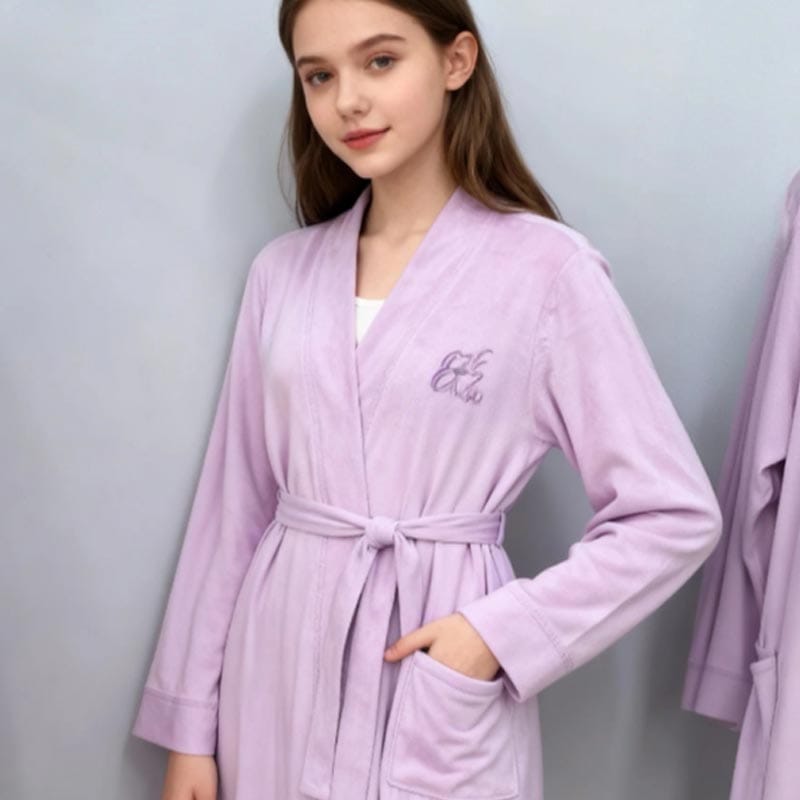
Show the decoration location on a technical drawing and measure from fixed points that the sample room can identify. Avoid an instruction such as chest position without a reference. Review the logo on worn custom bathrobes as well as a flat sample, since the front overlap and belt can shift its apparent location. For custom bathrobes with several sizes, ask how placement will be handled across the range. Approve that approach rather than assuming one coordinate creates the same visual proportion everywhere.

Compare stitch appearance on the selected surface
Review a physical embroidery trial for legibility, edge definition and the relationship to the surrounding texture of the custom bathrobes. Observe whether raised fibers obscure small lettering or whether dense areas make the material stiff. Ask the supplier to identify the approved embroidery reference and any underlay or supporting construction used. Compare thread shades under consistent lighting. A polished digital mockup can help communicate intent, but it cannot demonstrate the actual hand feel, surface interaction or dimensional effect of the stitched decoration.
Inspect backing and skin contact inside the robe
Turn the sample inside out and examine the reverse of the decoration. Check for rough ends, concentrated thickness and backing edges that may rub during wear. Ask how the reverse will be finished on production garments. Evaluate the area after the proposed care procedure as well as before it. Custom bathrobes should be approved for their inner finish and comfort, not only for the front-facing logo. If a backing change is proposed, review a new trial on the same material.
Keep pockets and front overlap functional
If embroidery is placed on or near a pocket, verify that the opening remains usable and the pocket bag has not been inadvertently caught in the construction. Review the logo with the robe tied normally and inspect whether the front overlap hides part of the design. Check the appearance with the wearer seated and moving. A placement can be correct on the flat pattern yet awkward on the body. Record the complete garment observations before deciding whether to move or resize the decoration.
Review decoration after the intended care procedure
Compare the complete sample before and after the proposed washing and drying routine. Look for puckering, thread changes, backing behavior and distortion of the surrounding fabric. Keep the test specimen and procedure identifiable. If the buyer requires a particular wash durability claim or institutional laundry performance, agree a suitable evaluation with the supplier and laboratory. Do not infer suitability for repeated commercial laundering from a home-care sample check. The expected use must be part of the development brief.
Control artwork versions and personalized order data
For custom bathrobes with a uniform brand logo, keep one final artwork reference and placement record. If individual names or different designs are requested, confirm whether the supplier can support that order structure and define how the data will be checked. Avoid mixing unapproved spelling changes into a production list. Reconcile decoration quantities with complete robe quantities and packing codes. Before release, ask for acknowledgment of the approved artwork, material, embroidery trial and garment placement so commercial and technical teams are working from the same version.
A practical decision example
Compare one change at a time
Imagine a logo that looks sharp on a digital robe mockup but becomes difficult to read when stitched on a raised fleece. Compare a physical trial with the original artwork and identify which letters or spaces have lost definition. Ask the brand owner to approve a simplified or resized version, then test it on the same material. Inspect the reverse and review the worn position before changing the final order file. After the care trial, retain the approved decoration sample with the robe reference. This hypothetical sequence keeps artistic and technical decisions connected. It does not guarantee that every logo can be embroidered at any size or that personalized one-off production is available without supplier confirmation.
Decision table
| Item | Approval evidence | Record to retain |
|---|---|---|
| Artwork | Accepted stitch interpretation | Version and color references |
| Placement | Flat and worn garment review | Measured landmarks |
| Backing | Inside finish and care comparison | Approved construction |
| Packing | Decoration code matched to robe | Complete-unit content check |
Make the approval reference usable on the production floor
Prepare an approval reference that a cutter, sewing supervisor and inspector can all interpret. Include the style code, revision date, front and back technical drawings, the fabric reference and the component list. Give each measurement a clear start and end point. State whether the garment is relaxed, gently extended or measured after a defined care procedure. Keep aesthetic approval separate from dimensional and workmanship approval so a good color match cannot conceal an unresolved construction issue. File a photograph of the approved reference with the written comments.
When several garments form one retail unit, review the unit as well as each component. Check that the agreed sizes are paired, the colors coordinate and the customer receives the intended number of pieces. Ask the packing team to use the same style and revision identifiers as the purchase order. Keep one retained complete set for later comparison. If production proposes a material or trim replacement, ask for a documented review of its effect on appearance, fit, care and cost before accepting the substitution.
Compare the relevant product range and development context with your intended customer and order. Confirm any requested material, size or construction option before treating it as available.
References for the review
Use the relevant primary resources when framing market and test questions: FTC textile guidance, FTC care guidance, AATCC methods, ISO care symbols. Confirm the applicable scope and methods with the responsible specialist for the actual product and destination.
Discuss the proposed order
For your custom bathrobes project, send the design reference, intended customer, destination market, complete-unit quantity and size breakdown. Include the specific decisions described above and identify any material or construction that still needs confirmation. Review Xiuxinyang OEM/ODM services and contact the team with your custom bathrobes brief to discuss the appropriate sampling and order requirements.
Frequently asked questions
Can custom bathrobes use any logo size?
Feasibility depends on artwork detail, material, placement and the proposed embroidery construction. Request a physical trial and confirm the accepted size with the supplier. A digital mockup does not establish production capability.
How should embroidery position be specified?
Measure from clear garment landmarks and include a drawing. Review the position on the worn robe, considering front overlap, belt and pocket access. Confirm how placement is handled across the approved size range.
Why inspect the reverse of the logo?
Backing, thread ends and dense stitching can affect contact comfort and garment flexibility. Inspect the inside before and after the proposed care procedure. Keep the approved reverse construction with the decoration reference.
Can each robe have a different name?
Treat individual personalization as an option that needs supplier confirmation. Agree the data format, spelling approval, quantities, order codes and packing method before assuming that a uniform logo order can support different names without changes.
What should the inquiry include?
Provide the robe design, material preference, original artwork, intended placement and use context. Add quantities, size breakdown, destination market and laundry expectations. Ask which artwork details or production assumptions need a physical trial.