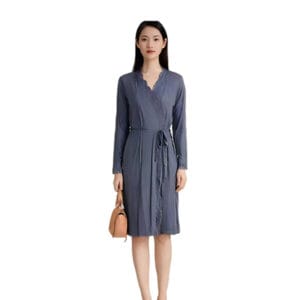
A wrap-front coral fleece sleep robe with a tie belt for private label homewear collections. Develop the length, front overlap, fabric weight and print around your customer profile. Men's and women's references; sizes S-XL. Reference MOQ: 1,000-2,000 robes, with flexible arrangements subject to project review.
A custom coral fleece robe adds an easy outer layer to a homewear collection: a wrap front for adjustable coverage, a tie belt at the waist and long sleeves for relaxing around the house. This reference is a sleep robe or dressing gown, not a pajama set. Each ordered unit is a robe with its agreed belt; the clothing worn underneath in lifestyle images is not included.
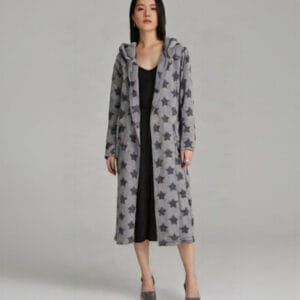
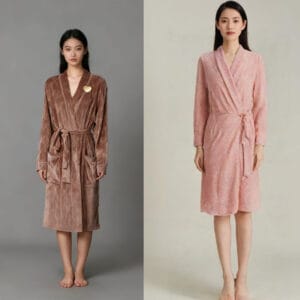
The gallery shows a gray star-print men’s reference and a pink printed women’s reference, both with front pockets. Xiuxinyang can discuss the length, fabric weight, print and brand presentation around your target customer. Start with how the robe will be worn over sleepwear, then develop the fit and material together.
| Detail | Reference and development scope |
|---|---|
| Product type | Single sleep robe or dressing gown for homewear |
| Construction | Long sleeves, wrap front, tie belt and front pockets shown in the references |
| Material direction | Coral fleece; agree final fiber composition, construction and finish with the selected swatch |
| Gallery versions | Gray star-print men’s reference and pink printed women’s reference |
| Size references | S, M, L and XL; finished measurements follow the approved size chart |
| Length | Specify the finished garment length for the intended wearer height |
| Fabric weight | Customizable; record the agreed value and unit with the finish |
| Branding | Print artwork, labels and packaging requirements available for discussion |
| Reference MOQ | 1,000-2,000 robes; flexible arrangements subject to project review |
| Selling unit | One robe with its agreed belt; no separate pajama garments included |
Confirm the minimum and allocation across styles, colors and sizes with the quotation. The men’s and women’s photographs are separate fit references, not proof that one measurement chart suits every customer.
Consider the robe as part of a homewear outfit rather than as an isolated garment. A customer wearing a lightweight camisole underneath needs a different layering allowance from someone wearing a long-sleeve pajama top. Define the intended underlayer so the sample can be assessed under realistic conditions.
Robe length also changes the wearing experience. A shorter version leaves more freedom around the lower legs, while a longer version provides more coverage but needs a careful sitting and walking check. Specify the finished length and intended wearer height rather than relying on a lifestyle photo to establish where the hem will fall.
This reference is for lounging and bedtime layering. It is not presented as an absorbent towel replacement, and the listing does not establish quick-drying or tested thermal performance.
The wrap front should provide the intended coverage before the belt is pulled tightly. On the fitted sample, review the front while standing, sitting and reaching. If the fronts separate more than your brief allows, revisit garment width and overlap rather than treating a tighter belt as the only solution.
Assess where the belt sits relative to the wearer’s waist and how the front hangs after tying. Review belt length, width and the placement of any belt loops together. A belt that works for one sample size may need a different length for the rest of the range.
Include chest width, shoulder position, sleeve length, sleeve opening and robe length in the measurement sheet. Check that the collar lies comfortably and that the front does not become unnecessarily bulky where the fabric overlaps.
Sleeves should accommodate the intended underlayer without feeling restrictive. Check their length with the arms relaxed and while reaching forward; an attractive standing pose alone does not establish a useful everyday sleeve length. Review the opening as well as the length, especially if your customers will wear another long-sleeve garment underneath.
The reference pockets are part of the robe’s everyday convenience. Specify their position and dimensions so they are reachable without disturbing the belt or front overlap. Assess pocket attachment and how the front hangs with typical light items inside, using the intended sample rather than assuming a load rating.
Keep these details consistent with the length and proportions of each version. Simply enlarging the body while leaving the pockets and belt in the same positions may not produce the fit your size range needs.
Request the proposed coral fleece swatch and inspect its surface, reverse, pile and hand feel. The fabric name alone does not identify a complete material specification. Record the agreed fiber composition and finish before preparing customer-facing labels or descriptions.
Fabric weight can be customized, but a heavier material is not automatically the best choice. Review how it drapes at the collar, folds under the belt and feels across the overlapping front panels. A material that feels suitable as a flat swatch can behave differently when several layers meet on the robe.
When specifying grams per square meter, or GSM, use that value as fabric mass per area, not as a direct thickness or warmth rating. Evaluate the complete sample for your intended use. Agree care requirements and any necessary assessment of appearance, dimensions or surface condition after washing before approving the order.
Send your artwork with the required colors, repeat scale and orientation. For motifs such as the stars shown in the reference, decide whether an all-over repeat is sufficient or whether particular areas need controlled placement. Do not assume exact motif matching across fronts, pockets and collar unless it is included in the specification.
Review the print on the actual fleece surface. Pile and surface direction can affect how fine edges and small lettering appear, so a digital artwork preview is not a substitute for a material or garment sample. Check the belt and pockets alongside the main panels to keep the collection’s appearance coherent.
Specify brand labels, size identification and packaging separately. The packaging description should identify a single robe and belt, avoiding imagery or wording that suggests a full pajama outfit is supplied.
If a hood is central to your collection, compare the hooded coral fleece robe. For a different surface and length reference, review the women’s embossed long robe. Assess each option against its own material and fit specification rather than carrying assumptions from this design into another listing.
The wider custom homewear range can help you coordinate robes with other collection pieces. Keep robe quantities and pajama-set quantities separate when preparing the inquiry.
Include the chosen gallery reference, selling market, intended wearer and underlayer, measurement chart, fabric direction and print artwork. State the number of robes, proposed size/color allocation and requested delivery date. Add any specific belt, pocket, labeling or packing requirements so the quotation addresses the complete garment.
Discuss your sleep robe specification with Xiuxinyang to review the length, overlap and material as one development brief. Sampling arrangements, timing and final order conditions should follow the agreed specification.
No. The order unit is one robe with its agreed belt. Tops, trousers or other clothing shown underneath in lifestyle images are not included.
A shared chart can be evaluated if that is your intended collection strategy, but the reference images do not establish a universal fit. Define the target measurements and assess coverage, sleeves and belt position for the intended wearers.
Yes, fabric weight and finish can be discussed. Provide the desired feel or a material reference and assess the proposed swatch on a robe sample; weight alone does not determine thickness or warmth.
Do not assume it is. State the required motif placement and matching areas in the artwork brief so feasibility and execution can be agreed before sampling.
The reference MOQ is 1,000-2,000 robes, with flexible arrangements available for discussion. The minimum for each print, style or color allocation must be confirmed for your project; splitting the total does not automatically qualify every version.
Focusing on loungewear, the fabrics are comfortable and skin-friendly.
The design balances practicality and style, and offers a variety of styles.
Full range of loungewear - a combination of comfort and design.
Custom material options include jersey, terry, cotton, polyester-cotton, rayon, crepe, towel fabrics, polar fleece, and single-sided or double-sided fleece. Fabric weight can be customized. Confirm the selected composition, construction, weight and finish with the approved swatch and sample. Pajama sets are supplied complete; tops and trousers are not sold separately.
Qingdao Xiuxinyang International Trade Co., Ltd. is a modern knitwear manufacturing enterprise integrating design, R&D, production, hot stamping, printing, and sales.
We possess a comprehensive technological advantage, encompassing yarn selection, fabric development, and garment manufacturing. Equipped with automated sewing equipment, fully automatic rhinestone machines, printing systems, computerized embroidery equipment, and flexible production lines, we can combine multiple processes to meet diverse product requirements and satisfy our customers' high demands for quality, design, and functionality.